Showing posts with label China. Show all posts

Monday, May 23, 2016

One Hello

One of the most interesting things about travelling is getting to know the place, and getting to know the people.  In my travels, I have met many friendly faces...smiling faces...and I feel bad not knowing how to say hello in their language. For me, trying to speak their language, at least the very basic words (like "hello") is one way of honoring their culture. 


But saying hello is not merely a greeting-- it can be slightly complicated in some places. For some cultures, how you say it depends on the gender, age, status in the society, religion or culture of the person you are talking to. 


So...how do we say hello...let me count (some of) the Asian ways.


In Bangladesh, you say Salaam Aleykum ( which means "Peace be unto you.") or Salaam (Peace) when greeting a Muslim. Namaskar is used when greeting Hindus. Touching is not common so when doing the greeting, you either fold your hands or touch the forehead (when greeting Salaam).

In Bangladeshi costume..during an event in Dhaka, Bangladesh

In Pakistan, a predominantly Muslim country, the phrase As-Salam-u-Alaikum, is used. It means the same as Bangladesh' Salaam Aleykum. As-Salam-u-Alaikum is used when you are the first one to greet, but when you are responding to someone who greeted you first, you respond by saying Wa'alaikum Salaam ( "And upon you, peace"). There are also variations when greeting one male, one female, two people, multiple females and so on- but As-Salam-u-Alaikum will do in most situations.

Pakistan, with a Nepalese friend. 

Namaste is common way of greeting in the Indian subcontinent and this is used in India, and Nepal. Namaste means, "I bow to the divine in you" or "may our minds meet". When doing the namaste, the hands are put together infront of the heart,  with a very slight bow of head, to extend friendship, love, respect and humility. Namaste is used to greet someone older or an equal, but not someone younger.  Namaskar the more respectful form of namaste


Beautiful Nepalese village
The countries by the Mekong river, such as Cambodia, Laos and Thailand also put their hands together and slightly bows when greeting hello. Touching is considered rude, specially if you do not know each other.

The Cambodians do the sampaeh, or they place their hands together, with palms touching and bow their heads, when doing a formal greeting or if it is the first time to meet.  The formal greeting is "Choump reap sor".  An informal greeting does not involve doing the sampaeh and the phrase "Susaday"  is used. My Cambodian friend told me that where you put your sampaeh and how high or low you bow , depends on who you are talking to.  The lower the bow, the more respect you show.  Forehead level sampaeh is for the gods, eyebrow level is for monks and king, nose-level is for parents, older relatives and teachers, below the mouth-level is for bosses and older people,  chest level is for people of the same age and position.
Temples in Cambodia

In Laos, they also press their palms together to do the Nop. Similar to a sampaeh, the higher the nop, the greater the respect, except that the hands are never held above the nose level.  In a nop, the bow is slight and done together with a slight bend of the knees and a smile.  The nop is a deference to the "social order".  The person considered as socially inferior or younger is the first to nop.  When doing the nop for people of higher social standing and monks, the hands are held infront of the nose.  When doing the nop for people of equal social status, the hands are held at mouth level, or at chin level when addressing younger or people of "lower" social status.  The Laotian word for hello is Sabaidee or Sabaideebor which means  "Are you well?".

In one of the Laotian Buddhist temples

In Thailand, they do the wai, which is the same as the Laotian nop, along with the greeting "Sawatdi" or "Sawasdee".  "Sawatdi kha" is the more polite phrase to use when greeting a female while  "Sawatdi khrap"    is for greeting a male person. Sawatdi means all the good things like success, beauty, happiness and goodluck. 
Exploring the old capital city of Ayutthaya with a friend from Ecuador

The Philippines, unlike their Southeast Asian neighbors do not do the bow.  Filipinos greet "Kumusta ka?", which comes from Spain's "Como esta?".  One of the old practices is the mano, where  the younger ones presses  his or her forehead on the elder's hand to accept a blessing from the elder.  While doing the gesture, they say "Mano po" which means "Your hand please".  Mano is again another Spanish word, which means "hand". 

One of the old churches built during the Spanish time in the Philippines

In Indonesia "Apa Kabar" (How are you?) is used in informal situations.  In a more formal setting, "Selamat Pagi" (Good morning) is used if it is day time.  "Selamat Siang" or "Selamat Sore" is used if it is afternoon or night time, respectively. 


The gave me a welcome dance in Soe, Indonesia..nice people!!
In Timor Leste, owing to Portuguese legacy, greeting people, even strangers is common, using Portuguese greetings.  Bondia is used if it is morning, Boatardi is used after lunch and Boanoiti. Ola (Hello) is also used. Shaking hands likewise common or women kissing both cheeks, or air on both sides of the face.  

Market scene in Aileu district

In China, "Ni hao" is the Mandarin equivalent of an informal "hello".   "Nin hao", is the more formal form.  "Nimen hao" is for greeting a group of people. 


By the mother of all rivers in China, the Yellow River, with a Chinese friend.
Different phrases, different gestures.  One hello. One humanity.  

Tuesday, October 13, 2015

Travel Tips: Xian, China

Here are some information for those who will be travelling to Xi'an, China.  I hope they could be of use to you.

About Xi'an:

Xi'an is the capital of Shaanxi province. It was the capital of 13 dynasties in the past and as such, was the center of culture. It is now one of the tourist destinations in China. 


Arrival:

Visitors can fly directly to Xi'an Xianyang International Airport. International flights are all in the T3.  Those who arrive in Beijing may take the train between Beijing and Xian, which will take about 12 hours.  

Taxis and shuttles are available at the airport. Taxis from Xianyang Airport to the downtown hotels will take about an hour and costs around 140RMB (China's currency).  Shuttles cost around 25RMB per person. 

Currency Exchange: 

Currency in China is Yuan (RMB). 

At Xianyang Airport, currency exchange is located at Gate 324, 2/F of Terminal 3
Operating hours: 07:30-21:30
Service fee: RMB58 per transaction

Currency exchange is available in most banks in Xian.  Credit cards such as Visa, Federal Card and Mastercard are also accepted in many establishments.

Language:

In Xi'an, Mandarin Chinese is the main language and only a few people speak English. If you will be travelling by taxi, it is advised that you ask your friends or hotel staffs to write down your destination and hotel address in Chinese, so you can show them to the taxi driver.

Time Zone:

GMT + 8

Electric system

220 volts, 50Hz 

Hotels


  • Gloria Plaza Hotel  - 0086 29 87868855 (4 star)
  • Hyatt Hotel- 0086 29 87691234 (5 star)
  • Bell Towel Hotel0086 29 87600000 (4 star)
  • Xi’an Royal Hotel- 0086 29 87690000
  • The Bell & Drum Tower Hotel - 0086 29 87278276
  • Xi’an City Hotel - 0086 29 87219988
  • Grand New World Hotel - 0086 29 87218686
  • Citadines Central Xian - 0086 29 85761186


Working Time 
  • Government offices : 8:00a.m to 18:00p.m (Monday to Friday)
  • Banks: 9:00a.m to 17:00p.m (Monday to Friday) and 9:30 a.m to 15:00 p.m (Saturday and Sunday)
  • Shops: 10:00a.m to 21:00 p.m (Monday to Sunday)

Holidays:
  • International Labour Day:  first three days in May 
  • National Day: first week in October
  • New Year: January 1 
  • Chinese New Year or the Spring Festival: usually late January-early February, depending on the lunar calendar

Tip practices:

Tipping is not common except in star hotels and luxurious restaurants

Places to visit:
  • Terracotta Warriors (1 hour away from airport)
  • Ancient Xian city wall (within walking distance from downtown)
  • Big Goose Pagoda
  • The Bell  and Drum Tower
  • Shaanxi History Museum
  • Forest of Stone Steles
  • Hanyang Tombs


Sunday, October 11, 2015

Xi'an's Terracota Army: Protector of the First Emperor

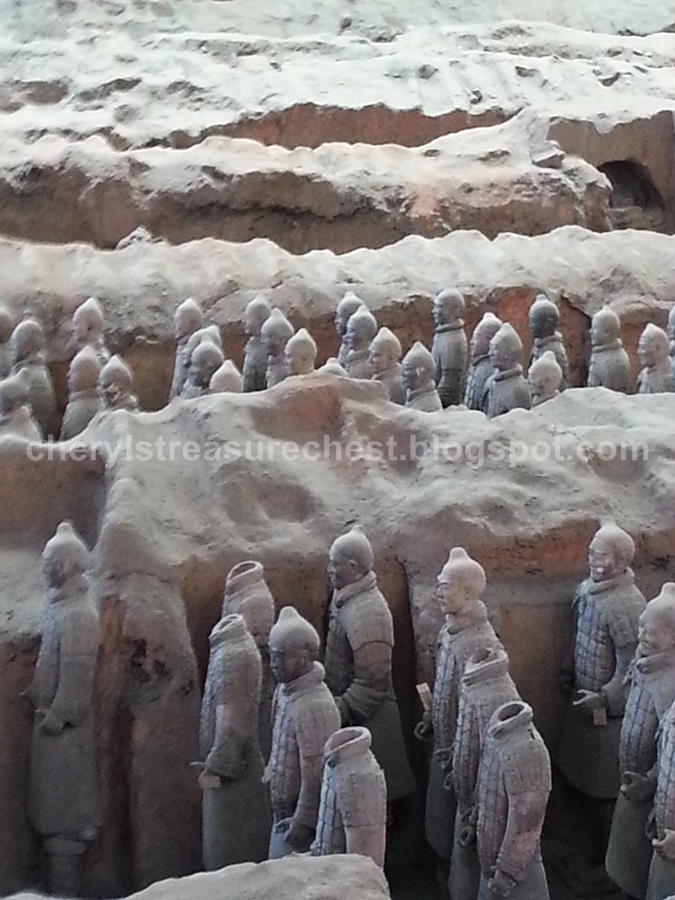
The first Qin emperor of China, Qin Shi Huang, has not only unified China during his rule from 221-207 BC. He also left behind a treasure, which can aptly be considered as another wonder of the world.  He built a mausoleum for himself- and thousands of life-size terracotta army, horses and chariots.  These terracotta army, arranged in battle formation near the Emperor's tomb, is believed to protect the Emperor in the life after.  Emperor Qin died in 209 BC and was buried with his terracotta army. They remained buried for 2,200 years, until the accidental discovery of the terracotta army in 1974, by some farmers digging a well. The mausoleum of Emperor Qin remained buried and not excavated to this day. 


Since it was opened to public in 1979, the Terracotta Army has attracted millions of visitors per year.  It is considered as one of the must-see in China, along with the Great Wall.  And I was not going to miss it for anything!

Our colleague has arranged for the taxi driver to take me and my colleague Shanta from Xi'an airport to the Terracotta Army museum, upon our arrival from YuLin. It's an hour drive from the airport.  We first had lunch then met with the tour guide which the driver has arranged for us. The tour guide showed us where to buy the admission tickets, we queued, bought our tickets,  and started with the tour. It was a bit of a walk through a nice garden, from the gate to the exhibitions.  


Ticket booths

Everybody off to see the tarracotta army

And here we go.....

The mausoleum and the terracotta army museum is in a 20 square mile compound. There are 3 exhibitions, showcasing the 3 pits of terracotta warriors.  We entered the biggest building, the 1st exhibition. It is where 6,000 terracotta solders were found. The tour guide shared that the figures used to have colors when they were first unearthed.  However due to exposure to air and light, the colors faded.  


The life-size terracotta soldiers (archers, cavalry, infantry and officers) are arranged  in battle formation along with chariots and horses. There were also 40,000 bronze weapons (spears, axes, crossbows and arrowheads) found in the pits.


Looking closely, each of the members of the army has distinct facial features and facial expression, height, and hair style.  Our guide shared that the artists then, copied the features of the of the Emperor's favorites among his soldiers.  


Our guide also shared that a number of laborers and artists, who helped in the construction of the tomb and of the terracotta warriors, were killed in order to preserve its secrecy.  


The 2nd pit or the 2nd exhibition has cavalry and infantry units.


The 3rd pit contains high ranking officers and chariots.


We headed to the souvenir shop. Our guide pointed to a man signing souvenir books by the entrance of the store.  He's one of the farmers who accidentally discovered the terracotta soldiers.  

I bought myself a replica of the kneeling archer, made from the terracotta soil.


The sales person said the kneeling archer is a symbol of luck.  I hope the kneeling archer will indeed bring me lots of luck, so that I will be able to see all of the world's wonders.

Friday, October 9, 2015

Getting to know JiaXian

Our second day at Jiaxian was the visit to the communities. JiaXian was mountainous, and the weather in the villages is cold.   


In the early morning and on our way to the communities, we dropped by a Daoist temple.  It was a nice one on top of a hill.  We brought some dried dates, one of the main products of Jiaxian.

The Daoist temple from afar...


We visited communities, talked to our partners, teachers, parents and the children. The people in the community were in awe when they saw Shanta, our colleague from Nepal because of her Nepali costume, and South Asian feature.  I, on the other hand, was again mistaken to be Chinese (but of course :-) ).


There is one reality in China , which I did not see in other countries I have visited.  In this part of the world, there is a  huge number of "left-behind" children.  These are children who had to stay school dormitories because their parents work in another place and there is nobody home to take care of them.  The school teachers or caretakers become their second parent.  And I believe, our organization's programs there is a good response to this situation.  We train the caretakers  and children about proper child care, nutrition, hygiene and about children's rights. This will enable the caretakers to take good care of the children, and knowing their rights, the children would also be able to take care of themselves.  And I commend our China colleagues for coming up with these programs- and also the school authorities and teachers for taking on the additional responsibility of being the caretakers of these children.


Children live and are cared for in these school dormitory


After the visit, we did a short debriefing about our findings together with our field office colleagues and our partners.  In the late afternoon, we traveled back to Yulin where we spent the night before we fly back to Xian. 


Wednesday, October 7, 2015

The Mother River of China and YuLin County.

Though both belong to the province of Shaanxi, we had to take a plane ride from Xian to YuLin. That is how vast China is.  

The driver of our JiaXian office was waiting for us at the airport when we arrived. He's a nice and funny guy who claims to be a fan of Manny Pacquiao (well -known boxer from the Philippines), who knew Pacquiao's rags-to-riches story.  Before we started our 2 hour travel to JiaXian, he took us to a noodle restaurant in YuLin, which he said is very popular. Each customer only pays around 1 dollar and can eat as many bowls of noodles as he/she can. There were many small bowls of herbs and condiments on each table, to mix and match.  It looked like a good business concept, judging from the many customers coming into the restaurant. 

My colleague , waiting to get started

Mix 'em and match 'em

The noodles was really good but easily filled me up. Our driver was able to finish around 8 bowls  of noodles (and these are not small bowls!) and he can finish more.The owner of the restaurant looked unhappy that I finished only 1 bowl and kept asking me (in Chinese) why I finished that little and if I did not like the taste.  Yang Min , our manager, and the driver, had to explain on my behalf.

After lunch, we started for Jiaxian.   Driving around YuLin, it was easy to notice that several new buildings were sprouting all over the city.  Yang Min shared that it was not like this before they discovered that their soil is rich in coal. Coal mining made many ordinary people instant millionaires. We used to have an office in YuLin but because the city became very progressive, we decided we were not needed there anymore and we closed

YuLin

On our way to Jiaxian, we passed by the Yellow River, one of the longest rivers in China at more than 5,000 kilometers long. Considered as the "Mother River of China"   and the "cradle of Chinese civilization", it was the center of Chinese culture for some 2,000 years in the past.  Confucious, the ancient Chinese philosopher, was born in one of the villages by the Yellow River.  The yellow color came from the lose sediments it carries.  It looked dark yellow, bordering on brown. 

By the bridge

the Yellow River

Bridge over the mother river

My self and my friend Yang Min
We then embarked on the 2 hour drive to JiaXian. The road was really wide and well paved and it was a very smooth travel.   I wish we also have these roads in the Philippine provinces.

On the way to Jiaxian


We finally reached JiaXian, and after a few introductions, we proceeded with our meetings and interview.  In the late afternoon, we met with the representative of the government from the Women's Group , which is our partner in the area.  The head of the Women's Group welcomed us over (big) dinner.  

And, it was time to call it a day.  

Tuesday, October 6, 2015

Xi'an

There are news again of Chinese vessels intruding the Philippine territory.  As if their taking over of one of the islands in the Spratly's is not enough. These news scares me.  So when I was told that I was to do a review of our office in China, I was scared. I wanted to see China, but not at that time when our dispute over the islands was on all time high. 

I was anxious all throughout my flight to Xi'an.  I have heard about the propaganda the Chinese government has spread against the Philippines, Vietnam, and other Southeast Asian countries whose islands, they have interest on.  I was prepared to be harassed at the immigration, and be treated badly as what some Filipinos have experienced in Beijing.

To my surprise, I did not experience any of that in Xi'an.  I guess they are far from Beijing so they are not that aware of the issues between our countries.  The immigration officer looked so young, and he was very nice and even welcomed me to China.

And I was doubly surprised that many people thought I was Chinese! (How come?). And I did experience a lot of kindness. The people in our office (both in Xian and Jiaxian) were very nice (and many looked fashionable :). They were very open in sharing their processes and procedures, important information I needed to be able to do my review and be able to provide with feedback later.  

Also, our partners from the government , were very cooperative during the interview.  Not to mention that they prepared delicious Chinese dishes for me.  

I totally did not expect it- those were pleasant surprises.  

But  there was one unpleasant surprise: when I tried to open Facebook, I was not able to. And I just found that their government has banned Facebook in China.  Same thing as Google and YouTube.  What??


View of the mall from my room in Xian...
The fancy hotel next door....