Showing posts with label Thailand. Show all posts

Monday, May 23, 2016

One Hello

One of the most interesting things about travelling is getting to know the place, and getting to know the people.  In my travels, I have met many friendly faces...smiling faces...and I feel bad not knowing how to say hello in their language. For me, trying to speak their language, at least the very basic words (like "hello") is one way of honoring their culture. 


But saying hello is not merely a greeting-- it can be slightly complicated in some places. For some cultures, how you say it depends on the gender, age, status in the society, religion or culture of the person you are talking to. 


So...how do we say hello...let me count (some of) the Asian ways.


In Bangladesh, you say Salaam Aleykum ( which means "Peace be unto you.") or Salaam (Peace) when greeting a Muslim. Namaskar is used when greeting Hindus. Touching is not common so when doing the greeting, you either fold your hands or touch the forehead (when greeting Salaam).

In Bangladeshi costume..during an event in Dhaka, Bangladesh

In Pakistan, a predominantly Muslim country, the phrase As-Salam-u-Alaikum, is used. It means the same as Bangladesh' Salaam Aleykum. As-Salam-u-Alaikum is used when you are the first one to greet, but when you are responding to someone who greeted you first, you respond by saying Wa'alaikum Salaam ( "And upon you, peace"). There are also variations when greeting one male, one female, two people, multiple females and so on- but As-Salam-u-Alaikum will do in most situations.

Pakistan, with a Nepalese friend. 

Namaste is common way of greeting in the Indian subcontinent and this is used in India, and Nepal. Namaste means, "I bow to the divine in you" or "may our minds meet". When doing the namaste, the hands are put together infront of the heart,  with a very slight bow of head, to extend friendship, love, respect and humility. Namaste is used to greet someone older or an equal, but not someone younger.  Namaskar the more respectful form of namaste. 


Beautiful Nepalese village
The countries by the Mekong river, such as Cambodia, Laos and Thailand also put their hands together and slightly bows when greeting hello. Touching is considered rude, specially if you do not know each other.

The Cambodians do the sampaeh, or they place their hands together, with palms touching and bow their heads, when doing a formal greeting or if it is the first time to meet.  The formal greeting is "Choump reap sor".  An informal greeting does not involve doing the sampaeh and the phrase "Susaday"  is used. My Cambodian friend told me that where you put your sampaeh and how high or low you bow , depends on who you are talking to.  The lower the bow, the more respect you show.  Forehead level sampaeh is for the gods, eyebrow level is for monks and king, nose-level is for parents, older relatives and teachers, below the mouth-level is for bosses and older people,  chest level is for people of the same age and position.
Temples in Cambodia

In Laos, they also press their palms together to do the Nop. Similar to a sampaeh, the higher the nop, the greater the respect, except that the hands are never held above the nose level.  In a nop, the bow is slight and done together with a slight bend of the knees and a smile.  The nop is a deference to the "social order".  The person considered as socially inferior or younger is the first to nop.  When doing the nop for people of higher social standing and monks, the hands are held infront of the nose.  When doing the nop for people of equal social status, the hands are held at mouth level, or at chin level when addressing younger or people of "lower" social status.  The Laotian word for hello is Sabaidee or Sabaideebor which means  "Are you well?".

In one of the Laotian Buddhist temples

In Thailand, they do the wai, which is the same as the Laotian nop, along with the greeting "Sawatdi" or "Sawasdee".  "Sawatdi kha" is the more polite phrase to use when greeting a female while  "Sawatdi khrap"    is for greeting a male person. Sawatdi means all the good things like success, beauty, happiness and goodluck. 
Exploring the old capital city of Ayutthaya with a friend from Ecuador

The Philippines, unlike their Southeast Asian neighbors do not do the bow.  Filipinos greet "Kumusta ka?", which comes from Spain's "Como esta?".  One of the old practices is the mano, where  the younger ones presses  his or her forehead on the elder's hand to accept a blessing from the elder.  While doing the gesture, they say "Mano po" which means "Your hand please".  Mano is again another Spanish word, which means "hand". 

One of the old churches built during the Spanish time in the Philippines

In Indonesia "Apa Kabar" (How are you?) is used in informal situations.  In a more formal setting, "Selamat Pagi" (Good morning) is used if it is day time.  "Selamat Siang" or "Selamat Sore" is used if it is afternoon or night time, respectively. 


The gave me a welcome dance in Soe, Indonesia..nice people!!
In Timor Leste, owing to Portuguese legacy, greeting people, even strangers is common, using Portuguese greetings.  Bondia is used if it is morning, Boatardi is used after lunch and Boanoiti. Ola (Hello) is also used. Shaking hands likewise common or women kissing both cheeks, or air on both sides of the face.  

Market scene in Aileu district

In China, "Ni hao" is the Mandarin equivalent of an informal "hello".   "Nin hao", is the more formal form.  "Nimen hao" is for greeting a group of people. 


By the mother of all rivers in China, the Yellow River, with a Chinese friend.
Different phrases, different gestures.  One hello. One humanity.  

Thursday, February 20, 2014

Chiang Rai Visit- November 2013

It was in November when I had the chance to visit Chiang Rai.  I have been travelling to Thailand for 13 years, but it has always been Bangkok, or recently, places closer to Bangkok. Chiang Rai is different- and lovelier.  Weather is cooler specially in the places on the hills.

The purpose of the visit was to "trouble shoot" and help our Chiang Rai office manage some of the issues with their operation. It was a bit stressful...but nonetheless, I found the chance one Saturday (and every night) to go around the city, on my own.

We stayed in a modest hotel right at the center of the city-- close to the night market and to the (countless) coffee shops. I am happy to note that I did not see a Starbucks coffee shop in Chiang Rai (as usually is the case in the cities I have been to). Instead, homegrown coffee shops are everywhere, which are, by the way, all very nice. My favorite is the one right by the Chiang Rai Clock Tower, where I have been going almost every night.


The Clock Tower is an attraction.  In the morning, you will see the gold plated clock tower amidst the gold plated island in the middle of the street.  At night, you are treated to free entertainment of Thai classical music for 15 minutes, while the clock shifts color for 15 minutes (every hour).

The Clock Tower during day time


Lights and Sound show at the Clock Tower during night time
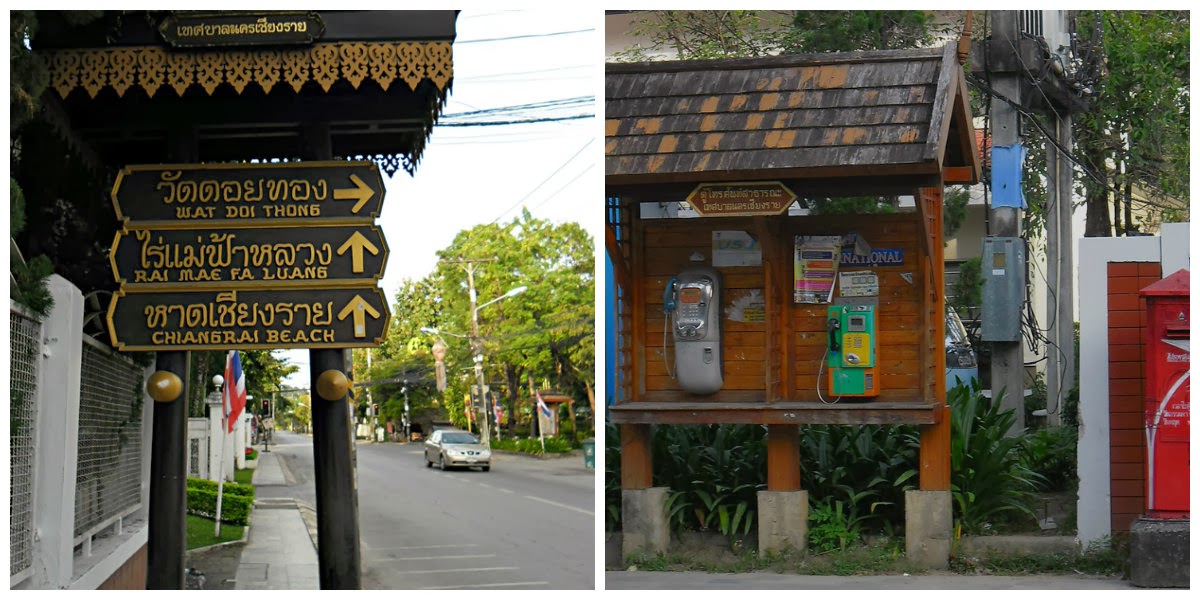
For several days my routine was: work until 5 pm, eat at cafe's or restaurants while watching the light and sound show at the Clock Tower, shop at the night market, and then back to the hotel.  On Saturday, I was able to finally explore the city. While walking, I can't help but notice how even the signboards and bus stops are so "Thai".
Sign boards and bus stops. Very Thai.
First stop was the Wat Phra Kaew, one of the oldest Buddhist temple in Chiang Rai .  It was where Bangkok's Emerald Buddha was found. The Wat Phra Kaew is located along Trairat road, Wiang Subdistrict, Muang Chiang Rai.  It is free of charge.Its a small place, but serene ,at least during my early morning visit. Monks were getting ready for the day, some were having breakfast.  

Early morning at the Wat Phra Kaew

Early morning at the Wat Phra Kaew


This temple was where Bangkok's Emerald Buddha was found. There is a replica of said buddha in the temple.

Replica of the Emerald Buddha

Replica of the Emerald Buddha

The most beautiful, however, are these lovely, colourful flowers, by the temple:
Lovely!

My next destination was the King Mengrai Monument. It was quite a walk from the temple but it was easy to find. This one is also for free.

King Mengrai Monument


My next destination was the Hilltribe Museum.  Owned by a non government organization, Population and Community Development Association, the museum will help one understand the culture of the different tribe groups in the area. I was not able to take photo of the museum though.

I did cap the day with the famous Thai massage and dinner of Chiang Rai Sausage (which is different than the other sausages because of its lemon grass taste).

Yummy Chiang Rai sausage

The following week, I got busy again with community visits and such...and occassional view of the tea plantations, and whatever else that came my way as we visit the villages by the hills.

Tea plantation, a woman coming home from work, and the on so lovable "mountain" dog 

It was such until Typhoon Haiyan hit the Philippines and we were ordered to go back to the Philippines to assist in the disastr.

Til then Chiang Rai.


Sunday, September 22, 2013

Cabbages and Condoms

"Oh by the way, I had dinner at Cabbages and Condoms", one of my friends told me. Cabbages and what?! Yes, I heard right. And no, it was not any of those sleazy places in Bangkok.

Cabbages and Condoms is a restaurant owned by a non-government organization (Population and Community Development Association). The restaurant both aims to provide financial support for the programs implemented by PDA as well as promotes the use of condoms for family planning. 

A very unique restaurant, C and C is artistically decorated with condoms, such as this:
Dressed in colorful condoms.
Walls, trees and lamps are likewise bedecked with..of course..condoms.

There are air conditioned rooms, but we opted to sit in the open air area when we visited. They serve mostly Thai food and I specially enjoyed #76 Pla Ka Pong Nueng Ma Nao (or steamed whole sea bass with chilli, lemons and vegetales). Complete set of menu, including prices (in Thai Baht) can be found in this link.

With my friends Rino, Fer and the yummy sea bass...

To support a good cause and for a good dinner, I will recommend Cabbages and Condoms any time. 

But hey, they do not give out free after-dinner mints.. only after-dinner condoms.


Cabbages and Condoms is located at 10 Sukhumvit Soi 12, Bangkok.


Saturday, September 21, 2013

Floating Market at the 75th Floor

Ever been to a floating market? What about a floating market at the 75th floor of a building?

The Baiyoke Floating Market, is located on the 75th floor of the Baiyoke Sky Hotel in Bangkok, Thailand.  The restaurant recreated the "Siamese bygone days" and life as they knew it. They have a wide selection of Thai and international dishes displayed on boats. 


I enjoyed tremendously all the seafood dishes , the Pad Thai (or the stir fried rice noodle) , and of course the varied dessert selection.

Thai food galore.

Desserts,desserts!

Souvenir items are also available for sale.

Keepsakes!

The fee includes both the buffet at the Baiyoke Floating Market as well as the Observatory Point at the 84th floor.  The revolving view point will give a 360 degree view of Bangkok. Which is quite nice...especially at night.


A very interesting dinner...and we all had fun.  It was a good night.


Baiyoke Floating Market is located at:
Baiyoke Sky Hotel, 222 Ratchaprarop Rd. Ratchathewi, Bangkok, Thailand
Telephone:: 66 2656 3000


Wednesday, September 18, 2013

Exploring Ayutthaya

 We were in the mood for some cultural exploration. Ayutthaya , the ancient capital of Thailand, and one of  the "World Cultural Heritage"-s , was our next destination


Only 45 minutes from Bangkok on a minibus, it was an easy (and cheap) trip.  When we reached Ayutthaya, a tuktuk driver approached us and offered a tour for the whole day, to 9 tourist places. 550 Baht per person sounded good enough (on hindsight we could have just rented bikes since the places were quite close to each other, except for the 2 temples).

Our first stop was the Wat Maha That, which was constructed in 1374 AD. It was said to be a royal monastery. Wat means monastery or temple, in Thai language.
At the Wat entrance


The big Buddha and the countless small headless Buddha figures -or "Buddhitas"- as my
 Spanish speaking friend calls them

Our second stop was the elephant ride...which I will never ever ever do again.  I dislike how the Mahot (or the trainor) treats the elephant and will never understand the need to constantly hit them with stick close to the ear! The ride made me sick.

Adorable creatures - in a cruel industry

Our third stop was the golden Buddha image known as Phra Mongkonbophit. It was located pretty close to the first wat we visited. It was surprising to see a number of monks, not on their knees, praying to their Buddha , but were instead very busy taking digital pictures. 

Me at the entrance of the Wat housing the Buddha

My friend Fer and the monk photographers


The Wat Phrasisanphet was our next stop- which was right beside the Phra Mongkonbophit. It was the former location of the royal palace in 1350 AD but a wat was built on the site in 1448 AD, which became the royal chapel.

Behind me are pagodas (chedis) which houses the remains of an ancient king
and his brother


Our next stop was my favorite among all the temples in Ayutthaya--the Wat Chaiwatthanaram. The locals call it Thailand's Angkor Wat (a very famous and grand temple in Cambodia).  Chaiwatthanaram is an ancient monastery established in 1630 AD.

As grand an entrance as can be


Our nth stop is the 37 meter long Buddha image called Phra Buddhasaiyart, where Buddhist offer prayers and flowers, and light their incense sticks.


Last stop was the Wat Phu Khao Thong-which was quite a climb but will give you a very nice view of Ayutthaya at the top.

What? Me? Climb? Nooooo!

And that concludes our Ayutthaya exploration.

Note to self: No temple visits again for the next 3 years. I had enough today to last me that. 


Sunday, September 15, 2013

A Day in Beach Garden Cha Am

I badly needed a break in June, as one would after a grueling first half of the year.  And since I have a workshop in Thailand at that time, and my Ecuadorian friend is coming over for my workshop, we made arrangement for a pre-workshop vacation.

We wanted to see the beach.  Phuket was out of the question because June is a stormy month and storms usually affect Phuket, as warned by our Thailand office security officer. We had to settle for places closer to Bangkok so we went for Hua Hin/Cha am-for some beach getaway and Ayutthaya , for some cultural exploration.  

Having did our research before travelling, we know our way-well, kind of. The mini bus station is located in Victory Monument, which can be reached via the BTS (train). Coming from Asok station, the terminal is at the left side exit of the Victory Monument station (Exit 2), right beside Century Cinema Mall. There are different booths for each destination- most are written in Thai. Luckily , the Hua Hin/Cha-am booth is in English.  

The booths at the mini bus terminal

We paid for our fare, got our ticket for 180 Baht each, and got confused :-D.  We were asked to wait for the minibus on one side-but it did take some time and the lady does not speak English. 

my "confused" friend

When the minibus finally came, we were expecting to board first since we were the first in the queue..which did not happen. So we ended up getting the most undesirable seat at the back-beside the luggages. It was however a fun 2.5 hours ride, with us talking all the way- which could probably have annoyed the other passengers. :)

We finally reached Hua Hin- and looked for a place to eat before boarding a taxi to Beach Garden Cha-am.  

Street food!

We reached the Beach Garden resort- and since we were booked for the cheapest room, we got the garden view, not the beach view..which kinda sucks because we went there for the beach. And so..we rushed to the beach, not wanting to miss the fun. And it was a clean, very nice beach...better than the beach at Amari Hua Hin hotel, where I was in March.


So nice that we stayed on until its dark...and had our Amarula drink, which came all the way from Africa. We had fun catching up, enjoying the wind and the sea, and trying to catch some pictures of lightning just for the heck of it.


And then it was dinner time at beach garden's restaurant.  We called it a day after dinner. We realized how badly we needed to rest.


Early morning was for catching the sunrise..we were surprised to see a bunch of young kids racing to the beach to do the same thing.  


Had quick breakfast, some time at the beach, a dip in the pool and then were off again to Bangkok to get ready for our Ayutthaya adventure the next day.