Showing posts with label Southeast Asia. Show all posts

Tuesday, July 28, 2015

Cambodian Lunch

Exhausted, but happy, from the Angkor Thom tour, me and my travel buddies were more than ready for lunch.  The weather was too hot and humid and we badly needed to be under the shade- even for a few minutes.

Our tour guide took us to a local restaurant across the Angkor temple. She left but will be back after an hour for the afternoon tour.

We were left on our own - with the non-English speaker servers.  It was a good thing that the menu has pictures- we only needed to figure the ingredients used in those dishes.

We ended up with really good dishes, anyways. I would recommend the visitors to try the following: 

Papaya Salad

Lobster with fried rice

Pineapple fried rice

Fish soup

Fresh buko juice

The cost per person is very reasonable (around USD 10 per person), considering that it is a tourist place. 


Sunday, July 26, 2015

Bayon: Ancient Temple in an Ancient City

Angkor used to be the capital of Cambodia, during the Khmer time from the 9th to 15th century. It is hard for me to believe that this forest, with several ruins, was where around a million people, with great culture, lived. It was said that in the 15th century the Khmer Kings abandoned Angkor. Angkor Thom lost its power and people abandoned the city for hundreds of years. (Read about the story of Angkor in bbc.com) Only the local monks and villagers know of this ancient city within the jungle until it was found in the 1860s and archaeologists came to uncover it.  And the great temple complex was revealed to the world. To date, around 2 million tourists come to see this enchanting place. 

Bayon temple ruins

Tourists..tons of them...and there's Carlos and Dracuse 

Angkor Thom was then the center of power, and is surrounded and protected by a wall. The Bayon temple, which is the temple of the King, is right in the middle of the Angkor Thom. The Bayon (or Prasat Bayon) is one of the must-visit temple ruins in Angkor Wat. Even in its current state, it is a beauty. 


The temple has galleries in the lower ground and several standing towers (it is said to have 37 remaining towers to date) We first explored the galleries in the lower ground. Our guide showed us the different sculptures (or they refer to it as bas-reliefs) in the wall. Through the bas reliefs, we were taken back to the Khmer time.  It reveals everyday life scenes of the Khmer during the 1200s and 1300s. This includes processions, market scenes and cockfighting. The bas reliefs also show historical scenes, which are mostly about battles: marching armies, horsemen, naval battle, and war machines.  Legends and mythology are also etched in the gallery walls. We were amazed at the details. I was wondering how many years it took them to carve everything , by hand. 


The upper terrace of the temple has towers. Each of the tower has three or four gigantic stone faces.  It is said that the upper terrace has more than 200 stone faces, each is around 13 feet tall. If only for these 800+ years old stone faces, Bayon is one of the most spectacular temples I have ever seen.


Bayon is a bucket-list worthy destination.  

Thursday, July 23, 2015

Angkor Thom

Angkor Thom (which means Great City) is a walled city inside the Angkor which was the capital of the Khmer empire.  It was built sometime in the 12th century and where the priests, and the palace and military officials lived. Now, the walled city is a huge complex with several ancient ruins. 

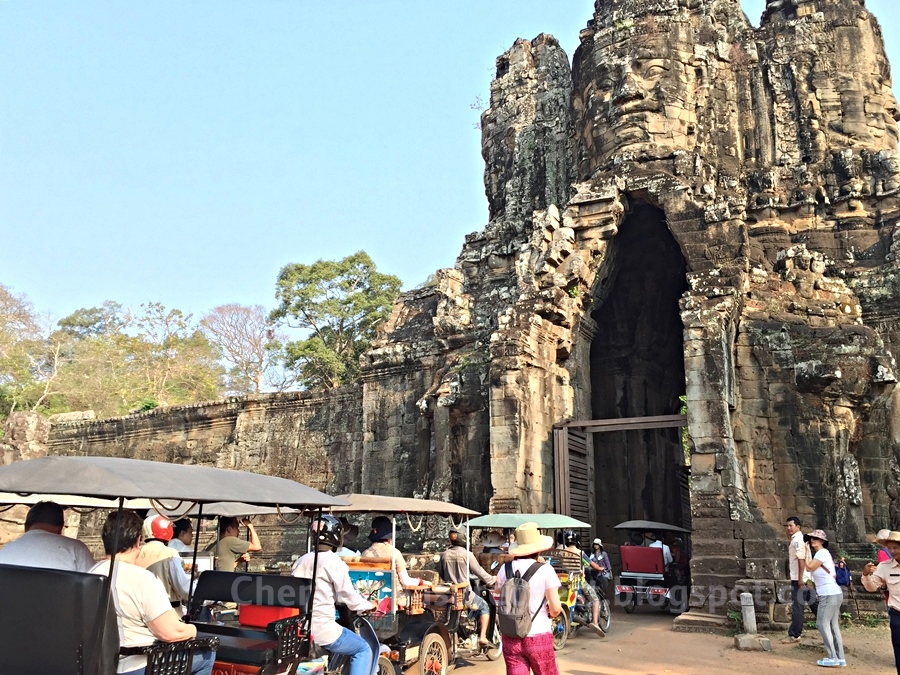
We entered the walled city of Angkor Thom via the South Gate.  There was traffic when we reached the gate.

Whoa...all roads lead to Angkor Thom

Traffic at the south gate
Near the gate, there are elephants which can be rented to take the guests around.
Yang Min, making sure I wont be able to run away from the elephant


The south gate has very interesting details. Giant faces, each showing different expressions, line up the road to the gate.  On the left side (if you are entering the city and facing the gate) are 54 figures of gods, whose expressions are either smiling, serious or serene. On the left side are 54 demons, with grimace on their faces. The gods are holding /pulling the head of a snake, while the demons are pulling its tail.

The demon gods

Rekha is not scared of them..

The south gate is an elegant entry tower. At the top of the tower are giant faces facing the four directions. The lower half are elephant statues with the figure of god sitting on each of the elephants.


The south gate is a lovely, elegant entry tower.  However, after I entered the walled city, I had to get out of it again. Work got in the way of my tour and I received a call to go back to the hotel for a short meeting about the workshop arrangements.  The tour guide was kind enough to ask the driver to take to the hotel, wait and take me back again to the Angkor Wat (and I only needed to add USD5 for the gas). What that meant however was me, missing the tour of the Elephant Court  and the other temples in the Angkor Thom. 

The good news was, when I came back, I was right on time for the Bayon temple ( well our kind tour guide has arranged for it so that I will be able to join the Bayon tour..shhhh).

Wednesday, July 22, 2015

Preparing to visit the Angkor Wat

I got really excited when I found that our annual network conference (which happened in March this year) was in Siem Reap, Cambodia. That meant I will finally be able to explore another ancient temple in Asia, the most famous maybe, the Angkor Wat.

I immediately got in touch with my friends from China, Yang Min, and from Nepal, Neeta to ask if they wanted to come a day early so we can do a tour. Of course, both said yes. Later, Rekha , from our office in Australia, Ranjit , from Canada, and Hailin from China also asked to join. I also emailed 2 colleagues who are new in the Asia Region, Dracuse from Haiti and Carlos from El Salvador-- my way of welcoming them to the region. (Later, however, Neeta was unable to join because of cancelled flights.)

Three weeks before our travel, I emailed Kimrom, a tour guide who promptly responded to my queries and sent me all the information that I need. Her rate is very reasonable: USD 100 for the 8AM to 5 PM tour , and this also includes the minivan and the driver who will pick us up from and take us back to the hotel, cold water during the trip and cold towel. Payment is done at the end of the tour.  

I have arranged for the tour, including the itinerary, and informed my colleagues, who were also very excited with the tour.  


On the day of the tour, Kim Ron was there before 8AM to pick us up at Somadevi Resort. It was everybody's first time to meet Ranjit, Dracuse and Carlos and it was funny how we were trying to guess who they are, from the many people in the hotel lobby :).  But we managed. Well, not after I kept ignoring the girl in pink dress, who kept smiling at me, never thinking that she is Ranjit- and all the while thinking that Ranjit is a male. Oh, well.....
Our tour guide in action

We reached the entrance of the Angkor Archeological Park in less than 30 minutes and Kim instructed us to queue to buy our pass, show our passport, and have our photos taken. The one day pass costs USD20 (they only accept cash in US dollars, Cambodian Riel, Thai Baht and Euro).  There is also a 3 day pass (USD40) and 7 day pass (USD60), which gives you the idea how huge the Angkor complex is.
Visitor's photo is printed in the pass, which makes for a good souvenir, but it also helps the government track the visitors, in case something goes wrong. Or in case somebody did something wrong like what some foreign visitors did recently: taking nude photos in the sacred temples. They got caught, by the way.
After we got out pass, we were reminded to keep and always carry our pass, as it will be checked when we enter major temples.  
And - we were ready to explore! 

Me and my travel buddies for the day
(PS. Visitors are advised to wear sturdy shoes, as there is a lot of walking involved.  Also bring sunglasses, hat and sunblock as it can be very hot and humid)

Sunday, July 19, 2015

The Wat Sisaket and the Monks-To-Be

Situated across the Palais Presidentiel along Lan Xang and Setthathirat Road,the oldest Wat in Vientiane is easily filled up with guests. Bus loads of tourists alighted at Wat Sisaket during my visit in January 2015.

There is an entrance fee to the wat for 5,000 kip (if I remember correctly). Visitors are free to take pictures in the garden within the courtyard, but not inside the main temple or the ordination hall.

Tourists and tour guide on the way to the courtyard, after paying the admission fee

Wat Sisaket was built in the early 1800s. At the entrance is a garden, golden Buddha statues, and the drum tower. 

The cleaner, at the wat's garden


The golden Buddhas

The drum tower, with Nagas guarding its stairway

Upon entry in the courtyard, there is the temple or the ordination hall. Those who enter the temple must leave their shoes or slippers outside. The temple is surrounded by the courtyard galleries which house thousands of seated and standing Budhha statues, of all sizes and made of wood, silver, bronze and ceramics. 

The temple or the ordination hall in the middle of the courtyard


The courtyard galleries

Wat Sisaket is also a monastery. There were a number of novice monks roaming around - cleaning, pushing carts, preparing offerings, talking and laughing. Young as they are, I cannot help but wonder if a monastery is a good enough place for these young children to grow up?


Tuesday, July 14, 2015

The Palais Presidentiel in Vientiane


Listed as one of the landmarks in Vientiane, the Palais Presidentiel is an imposing structure along Lane Xang street.  The Palais, built in 1973, is a huge, beautiful French building.
Monarchy in Laos has been banished in the early 70s, and therefore, no monarchy lives in the palais. It is now used for formal government ceremonies.


View from Lane Xang Street


I  wish it was possible to go inside or roam its garden, just like the beautiful palaces in Germany or in the United Kingdom.However, it is closed to the public.  When I passed by the palais, coming from the patouxai, there were government officials coming out of the palais ( complete with steady siren blasts to announce their presence and to clear the street so they can pass, unhampered, of course).  


The palais is a stone's throw away from the Chao Anouvong monument and park, which is the best place to view and take photos of the palais, as the park is not as busy as the Lane Xang Street. .


Thursday, March 7, 2013

Phnom Penh and the Wat Preah Keo

15% work, 80% leisure, 5% fright.  That was how our last day in Cambodia was spent. 

We were back in Phnom Penh the night before and spent our time preparing for the presentation of our visit findings/recommendations. It was a Friday and we were in the office at 8. The Country Director however had urgent meeting until lunch time.  While waiting, we decided to stroll at the park close to the office. 

At the park across our office.

Neeta, trying to chase the golden dragon at the park.
Across the park is the southern gate of the Royal Palace compound.


We then headed to the Royal Palace compound, which is just across the park, only to find out that the Royal Palace itself was closed. When we went in January, they were still in the "mourning period", which lasts for 3 months.  The father of their present king ,  Norodom Sihanouk, whom they fondly call Father King, has passed away in October 2012. During our visit, he still lie in state in the palace,  his face covered by a golden mask.  My Cambodian colleague shared that their Father King is well loved by the people, and many people still troop to the palace to pay their respect, months after he passed away.  At the time of our visit, the palace is already preparing for the cremation of their Father King.

Though we were not able to see the Cambodian Royal Palace, the Silver Pagoda , or the Wat Preah Keo, was open to the public.  The Silver Pagoda is within the Royal Palace compound and is the official wat of the King of Cambodia.

The Silver Pagoda in Phnom Penh

The Wat Preah Keo is called the Silver Pagoda because of its floor with more than 5,000 silver tiles.  The Silver Pagoda houses the Emerald Buddha, which is why it was also called Wat Preah Keo, or the "Temple of the Emerald Buddha".  Aside from the Emerald Buddha, the wat houses many (and I mean countless, myriad, bountiful, innumerable) Buddha images, including a solid gold Buddha with diamonds embedded in the chest and in the crown . Photo taking was, of course, prohibited. Sadly.

View of the Silver Pagoda from the Keong Preah Bath Shrine, which contains Budhha footprints

I love taking pictures of windows. Each place I have visited has its distinct window design.
Here is one from the Silver Pagoda.

The compound is surrounded by a nice garden, and gives a nice view of the Royal Palace.  
The garden at the pagoda compound and a view of the Royal Palace


There are several structures around the pagoda, like shrines and monuments.

The Dhammasala, an open hall which serves as reception area

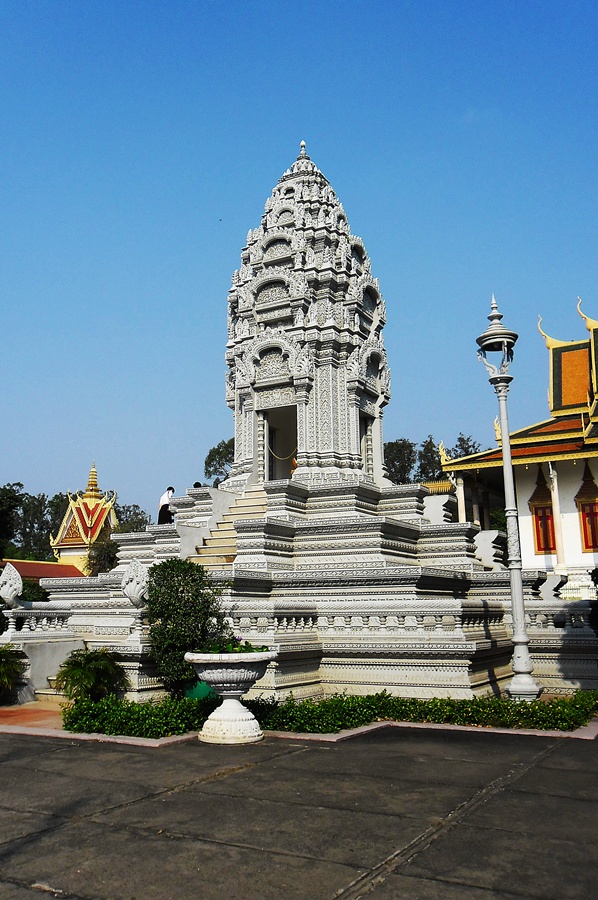
One of the Stupas of one of their late kings.

Stupa of Princess Kantha Bopha.

On top of the Kantha Bopha memorial.

We were back in the office by lunch time, had a presentation with the Country Director of our Cambodia office, had lunch and said goodbye to the Kampong Cham team who accompanied us to Phnom Penh.

We wanted to see the killing fields- and our office driver hired a tuktuk to take us there and back.  We had an unfortunate experience, however , with that tuktuk driver, who took us to a nearby museum instead. When we reminded him that our agreement was for him to take us to the killing fields, he said it was not so and if we wanted we have to pay more than what was agreed. After a long argument, we asked him to just take us back to the hotel and we paid him $4 for that very short trip. After we alighted the tuktuk, he was shouting at us, and was looking very angry. I guess because he didn't get what he wanted from us. He did look scary. So, I would say, I will never again take the tuktuk in Phnom Penh. I would rather the hotel arrange for taxi to take me to places next time.

So rather than the killing fields, we ended up at the Central Market, shopping for precious stones and some pasalubongs.  The haggling was another story.